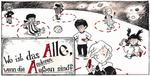
Illustration © Nikki McClure

contentarea top menu

Gender studies

Syndicate content


Artist Cordelia Donohoe has work currently showing as part of a V Day photography exhibition 5th – 20th March 2010 at the New Players Theatre, Villiers Street. London.

Topic: 
Art
Gender studies
Girls and young women
Sex and sexualities
Teaser Image: 

Tell me about the work you have been doing.
My recent bodies of work are around the notion of the prostitute, they are part of a dialogue about what creating a sexualized identity and advertising on the internet might mean. I take apart the process of taking photographs, I also use text and collage to question what one is seeing and who is being addressed. It is also a personal journey about my own relationship to my womanliness.

How did you get into doing this?

Interviewee: 
Cordelia Donohoe
Interviewer: 
Christina Olivieri
Tags: 
Feminism
art
photography


"Women's Studies International Quarterly" (1978-)

Digital Archives: 

Now: Women's Studies International Forum

Location

London
United Kingdom
51° 30' 0.5472" N, 0° 7' 34.4496" W
Topic: 
Gender studies
Grassroots media in Europe
Women's Liberation Movement


"Feminist Review" Journal (1979-)

Digital Archives: 

"New journal which aims to provide a bridge between the WLM and women's studies. Concerned with issues such as women and social control, sexuality, women's art, feminist criticism, and Third world women. First issue: Jan '79".

- Information from the "Directory of Women's Liberation Newletters, Magazines, Journals...", by Dena and Shaila (York, UK), c.1978

Location

London
United Kingdom
51° 30' 0.5472" N, 0° 7' 34.4496" W
Topic: 
Gender studies
Grassroots media in Europe


"Women's Research and Resources Centre Newsletter" (1975-?)

Digital Archives: 

"Set up in '75 to inform members of publications, meetings, and research. Bi-monthly n/l, circulation 1,000. Distributed by subs to men as well. Costs: ₤100 for one issue, self financing. 2 women work on the paper part time, and the collective is open to all women subscribers. The collective is unpaid, but only the paid workers do the N/L. The n/l is for all those interested in feminist research, and informs people of research, publications, and puts researchers in touch with each other. Editorial policy: so long as its feminist and relevant, they will print it, and they occassionally accept entries from men e.g. relevant book review.

- Information from the "Directory of Women's Liberation Newletters, Magazines, Journals...", by Dena and Shaila (York, UK), c.1978

Location

London
United Kingdom
51° 30' 0.5472" N, 0° 7' 34.4496" W
Topic: 
Gender studies
Grassroots media in Europe
Women's Liberation Movement


"Women's Studies Newsletter" (1977-?)

Digital Archives: 

"Set up in April '77, when it was made clear that there was demand to know more about women's studies, work in progress, ideas for the future. Circulation: 1,000-1,250. Distribution: subs, sold at few bookshops, through the Worker's Educational Association, meetings, etc. Available to men. Costs: ₤80 for an average issue. Not self-financing- get a grant from the EOC, donations, subs etc. Only 2 women do most of the production of the n/l, and it takes about 240 hours approx. for one issue. One full time unpaid worker, but they are trying to negotiate for payment.

Location

Stourbridge
United Kingdom
52° 27' 19.9512" N, 2° 8' 35.6388" W
Topic: 
Gender studies
Grassroots media in Europe


European Feminisms: Books, Articles, Websites

Books
Jane Slaughter and Robert Kern, European Women on the Left: Socialism, Feminism, and the Problems Faced by Political Women, 1880 to the Present , Westport, CT: Greenwood Press, 1981.

Gisela Kaplan, Contemporary Western European Feminism, New York, NY: NYU Press, 1992.

T. Akkerman, Perspectives on Feminist Political Thought in European History: 1400-2000 , London: Routledge, 1998.

Type of Resource: 
Books & Articles
Topic: 
Gender studies
Grassroots media in Europe
History


AOIFE: Association of Institutions for Feminist Education and Research in Europe

Image: 

AOIFE is a European association for Women's Studies based on institutional membership.
AOIFE is a structure which links institutions dedicated to initiating and supporting feminist education and research in Europe.
AOIFE is a forum for collectively addressing and acting on issues concerning Women's Studies by means of co-operation and networking.
AOIFE is a platform from which to submit carefully drafted applications for funding from the EU and other international organisations.

Type of Resource: 
Networks
Topic: 
Gender studies


WISE: Women's International Studies Europe

Women's International Studies Europe (WISE) is the European association for individuals and institutions involved in women's studies, founded in 1990. WISE seeks to further feminist critiques of knowledge, and support practices and research, which will improve the quality of women's lives.

WISE aims to promote women's studies teaching, research and publication in Europe and defends the interests of women's studies on a European and international level in all appropriate institutions and organizations.

Type of Resource: 
Networks
Topic: 
Gender studies


ATHENA: Advanced Thematic Network in Activities in Women's Studies in Europe

Image: 

ATHENA is a Socrates Thematic Network Project in which 80 Women's and Gender Studies Programmes at universities, research institutes and documentation centres in Europe participate. ATHENA was created in 1996 by the Association of Institutions for Feminist Education and Research in Europe (AOIFE), and was selected as a Socrates Thematic Network Project in September 1998. The ATHENA central coordination is located at Utrecht University, the Netherlands.

Type of Resource: 
Networks
Topic: 
Gender studies


Regional Network for Gender/Women's Studies in Southeastern Europe

Image: 

Background

The regional educational (institutional) context and needs for the gender/women’s/feminist studies:

As far as the gender/feminist studies education is concerned, a shared feature in the region of Southeastern Europe is its utter absence from the institutions of the official higher education. Or, in the brighter cases (e.g., the University of Sofia where there is an integral postgraduate program, or University of Skopje offering several courses), one can speak of this field’s radical marginality, consisting in a low position on the scale of power relations (poor funding, invisibility, etc.) In many countries of SEE, the feminist scientific and theoretical thought and the production of knowledge (including education) have functioned on an informal level, in alternative spaces and, by doing so, have represented an opposition – thus, alternative and supplement – to the formal higher education. Nevertheless, the official production of knowledge and of what is considered competent professional formation rigidly maintains its ban to – according the dominant discourses - the “non-scientific” gender studies: “non-scientific” since knowledge is still deemed to be irrevocably universal and, thus, genderless/sexless.

Type of Resource: 
Networks
Topic: 
Gender studies